Aaq Nama – Legal Meaning, Urdu Format, Draft Structure & Inheritance Reality (عاق نامہ)
Family disputes can sometimes escalate to a point where parents feel compelled to formally disassociate from a son or daughter. In South Asian culture, this declaration is commonly known as Aaq Nama (عاق نامہ). Many people search for Aaq Nama Urdu formats or an Aaq Nama draft when facing serious family conflicts, especially those involving property or inheritance.
However, before preparing such a document, it is crucial to understand its legal position, Islamic perspective, and practical consequences. This detailed.
What Is an Aaq Nama?
An Aaq Nama is a written declaration in which a parent states that they consider their child “Aaq” (disobedient) due to persistent misconduct, disrespect, or serious family disputes.
In religious terminology, “Aaq” refers to a child who:
Disobeys parents repeatedly
Causes emotional or financial harm
Breaks family ties
Acts against family values
While the term carries moral weight, its legal enforceability is often misunderstood.
Legal Status in Pakistan
Family and inheritance matters in Pakistan are primarily governed by Islamic personal law and statutes such as the Muslim Family Laws Ordinance, 1961.
Important Legal Reality
A written declaration of disownment does not automatically:
Cancel inheritance rights
Remove a legal heir from succession
Transfer ownership of property
Override fixed Islamic shares
Under Islamic inheritance principles, children are entitled to predetermined shares after the death of a parent. These shares generally cannot be revoked through a simple written statement.
This is where many misconceptions arise.
Why Do Parents Issue Such Declarations?
Although the legal effect may be limited, families still prepare such documents due to:
1. Property Disputes
Conflicts over business assets or real estate.
2. Marriage Without Consent
Especially in cases of love marriages against parental wishes.
3. Financial Misconduct
Allegations of exploitation or misuse of money.
4. Repeated Disrespect
Severe behavioral issues or public family disputes.
5. Emotional Breakdown
Long-standing conflicts leading to strained relationships.
Often, these actions are driven by emotion rather than legal strategy.
Does It Cancel Inheritance?
This is the most frequently searched concern related to عاق نامہ.
The Short Answer: No.
Under Islamic inheritance law:
Shares are fixed by Shariah principles.
A parent cannot eliminate a legal heir merely through a declaration.
Distribution happens after death according to prescribed shares.
If someone wants to manage property distribution during their lifetime, legally recognized tools must be used instead.
Difference Between Disownment Declaration and Gift Deed
Understanding this difference prevents costly legal mistakes.
| Declaration of Disownment | Gift Deed (Hiba) |
|---|
| Emotional/social action | Legal property transfer |
| Often unregistered | Registered and enforceable |
| Does not defeat inheritance | Transfers ownership immediately |
| Limited legal impact | Strong evidentiary value |
If property protection is the real objective, a properly executed gift deed is far more effective than relying on emotional declarations.
Proper Structure – Draft Format
For informational purposes, below is a structured template often used when preparing such a declaration.
1. Title
Declaration of Disownment
2. Personal Details
Full name
CNIC number
Address
3. Child’s Information
Name
CNIC (if applicable)
Relationship
4. Statement
Clear wording stating the child is being declared disobedient due to specific reasons.
5. Voluntary Clause
Confirmation that the declaration is made without pressure.
6. Signatures
Declarant’s signature
Two witnesses
Date and place
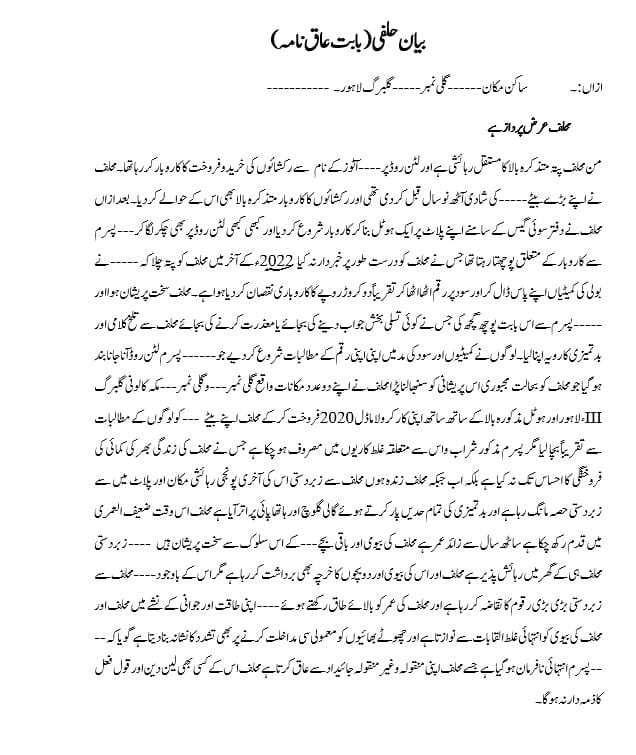
Urdu Format Sample (عاق نامہ)
Many readers look specifically for an Aaq Nama Urdu version. Below is a simplified format:
عاق نامہ
میں، (نام)، ولد/دختر (والد کا نام)، رہائشی (مکمل پتہ)، شناختی کارڈ نمبر (نمبر)، یہ اعلان کرتا/کرتی ہوں کہ میرا بیٹا/بیٹی (نام) مسلسل نافرمانی اور نامناسب رویہ اختیار کیے ہوئے ہے۔
ذاتی اور خاندانی وجوہات کی بنا پر میں اسے آج کی تاریخ سے عاق قرار دیتا/دیتی ہوں۔
یہ بیان میں نے بغیر کسی دباؤ کے اپنی مرضی سے دیا ہے۔
دستخط: ______
تاریخ: ______
گواہان: ______
This sample reflects commonly used wording but does not guarantee legal enforceability.
Is Newspaper Publication Necessary?
Some individuals publish such declarations in newspapers. While publication may:
It still does not automatically cancel inheritance rights under Islamic law.
Islamic Perspective on Disownment
Islam places strong emphasis on:
Although “Aaq” is recognized as a moral classification, inheritance shares are divinely prescribed. Most scholars advise reconciliation before taking extreme measures.
Common Misunderstandings
Misconception 1: It Removes Legal Heir Status
Incorrect.
Misconception 2: It Prevents Court Claims
Not necessarily.
Misconception 3: It Overrides Islamic Law
It does not.
Misconception 4: Registration Makes It Final
Registration may strengthen documentation but does not override fixed inheritance shares.
Better Legal Alternatives
If the concern is primarily about asset protection, consider:
1. Gift Deed (Hiba)
Transfer property legally during lifetime.
2. Will (Wasiyat)
Distribute up to one-third of estate to non-heirs.
3. Family Settlement Agreement
Resolve disputes amicably in writing.
4. Trust Structure
Manage property under formal arrangement.
These methods carry stronger legal weight compared to a simple declaration.
Emotional vs Legal Consequences
Emotionally, drafting such a document may feel like a decisive step.
Legally, its power is limited and may lead to:
Therefore, careful consideration is essential.
When Should You Avoid This Step?
Avoid preparing such documentation if:
The dispute is temporary
Reconciliation is possible
Minor grandchildren are affected
You are acting out of anger
You have not received legal advice
Family mediation is often a healthier alternative.
Practical Advice Before Drafting
Before finalizing any declaration:
Consult a qualified family lawyer.
Understand Islamic inheritance rules.
Evaluate proper legal tools for asset protection.
Consider mediation or counseling.
Think about long-term consequences.
Decisions made in anger can create permanent regret.
Final Thoughts
An Aaq Nama (عاق نامہ) is primarily a cultural and emotional declaration rather than a strong legal instrument. While many people search for an Aaq Nama draft or an Aaq Nama Urdu format, it is essential to understand that inheritance rights under Islamic law are generally fixed and cannot be revoked simply by issuing such a statement.
If property distribution is your main concern, legally recognized tools such as gift deeds or wills provide more reliable protection. Emotional disputes should ideally be resolved through dialogue and mediation rather than permanent public declarations.
Careful legal guidance, patience, and awareness are the best safeguards when dealing with sensitive family matters involving property and inheritance.