Federal Constitutional Court Cause List – Islamabad, Karachi, Lahore, Peshawar & Quetta Benches
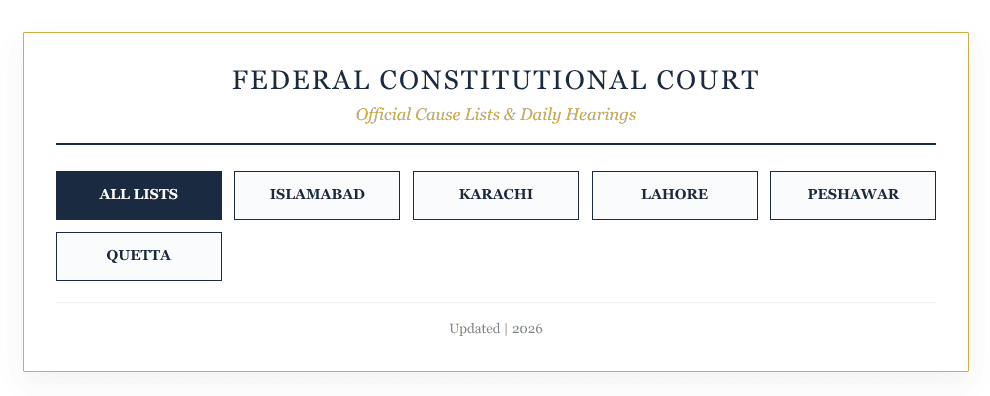
The Federal Constitutional Court plays a central role in upholding constitutional supremacy, ensuring rule of law, and safeguarding fundamental rights. One of the most important tools for legal practitioners, litigants, and researchers is the cause list, which provides a structured schedule of cases fixed for hearing before various benches of the court.
This article provides a comprehensive overview of the Federal Constitutional Court Cause List, with a particular focus on the benches operating in Islamabad, Karachi, Lahore, Peshawar, and Quetta. Understanding how these cause lists function is essential for lawyers, petitioners, and anyone interested in the judicial process.
What is a Cause List?
A cause list is an official document issued by a court that outlines the cases scheduled for hearing on a particular day. It contains critical details such as:
Cause lists ensure transparency and efficiency in judicial proceedings. They allow litigants and legal professionals to prepare in advance and track the progress of their cases.
Importance of the Federal Constitutional Court Cause List
The cause list of the Federal Constitutional Court is particularly significant because it deals with constitutional matters, including:
Interpretation of constitutional provisions
Enforcement of fundamental rights
Inter-governmental disputes
Public interest litigation
For lawyers and litigants, accessing the cause list means staying informed about when their case will be heard and before which bench.
For the general public, it offers insight into the functioning of the judiciary and ongoing constitutional matters of national importance.
Structure of the Cause List
The Federal Constitutional Court cause list is typically divided into several sections:
1. Principal Seat and Benches
The court operates through its principal seat and multiple benches across major cities:
Islamabad
Karachi
Lahore
Peshawar
Quetta
Each bench handles cases relevant to its jurisdiction while also hearing constitutional matters referred to it.
2. Types of Cases Listed
The cause list may include:
Constitutional petitions
Civil appeals
Review petitions
Public interest cases
Urgent applications
Cases are often categorized for clarity, such as fresh cases, fixed cases, and supplementary lists.
3. Bench Composition
Each case is assigned to a specific bench, which may consist of:
The cause list clearly mentions the judges presiding over each case.
Islamabad Bench Cause List
The Islamabad bench regularly publishes the Federal Constitutional Court Cause List, which includes high-profile constitutional matters and cases involving federal authorities.
Karachi Bench Cause List
The Karachi bench plays a vital role in addressing constitutional and legal issues arising in Sindh.
Key Features:
Handles commercial and constitutional disputes
Deals with cases involving provincial authorities
Frequently hears matters related to taxation and business regulations
Karachi’s cause list often includes a mix of constitutional petitions and commercial litigation, reflecting the city’s economic importance.
Lahore Bench Cause List
Due to the heavy caseload, the Federal Constitutional Court Cause List for the Lahore bench is frequently updated and closely monitored by legal professionals.
Peshawar Bench Cause List
The Peshawar bench serves the Khyber Pakhtunkhwa region and addresses constitutional matters specific to the province.
Key Features:
Handles regional constitutional issues
Deals with governance and administrative disputes
Focus on fundamental rights enforcement
The cause list here often includes cases related to land disputes, governance, and public service matters.
Quetta Bench Cause List
The Quetta bench caters to the province of Balochistan and plays a crucial role in ensuring access to justice in the region.
Key Features:
Addresses constitutional issues in remote areas
Deals with provincial governance matters
Handles cases involving fundamental rights
The Quetta cause list may be shorter compared to other benches but remains equally significant in ensuring justice.
Daily and Supplementary Cause Lists
The Federal Constitutional Court typically issues:
Daily Cause List
The daily Federal Constitutional Court Cause List provides a complete schedule of hearings, while supplementary lists include urgent and newly fixed cases.
How to Access the Cause List
The cause list is usually available through:
Most courts now provide online access, allowing users to download or view cause lists in real time.
Benefits of Checking the Cause List
For Lawyers:
For Litigants:
For Researchers:
Challenges Associated with Cause Lists
Despite their importance, cause lists may present certain challenges:
However, supplementary lists and digital updates have improved accessibility and accuracy.
Digital Transformation of Cause Lists
With digital advancements, accessing the Federal Constitutional Court Cause List online has become faster, more efficient, and user-friendly.
Role of Cause Lists in Judicial Transparency
Cause lists contribute significantly to judicial transparency by:
They serve as a bridge between the judiciary and the public.
Tips for Using the Cause List Effectively
To make the most of the cause list:
Check it daily for updates
Note the sequence of your case
Arrive in court on time
Monitor supplementary lists
Stay in contact with your legal counsel
These practices can help avoid confusion and ensure smooth participation in court proceedings.
Conclusion
In conclusion, the Federal Constitutional Court Cause List is an indispensable tool for navigating constitutional litigation in Pakistan. Whether you are following proceedings in Islamabad, Karachi, Lahore, Peshawar, or Quetta, staying updated with the Federal Constitutional Court Cause List ensures awareness, preparedness, and effective participation in the legal process.