Federal Constitutional Court Cause List
A Constitutional Court Cause List is one of the most essential judicial documents for lawyers, litigants, journalists, and researchers seeking to understand the functioning of a constitutional adjudicatory body. Although many countries maintain their own systems for scheduling cases before constitutional or supreme courts, the idea of a Federal Constitutional Court—a court specifically empowered to interpret and protect the constitution—remains central to modern constitutional governance. In discussions related to comparative constitutional law, the concept is often examined with reference to jurisdictions such as Germany, India, and Pakistan. While Pakistan does not formally use the title Federal Constitutional Court, the Supreme Court of Pakistan performs this role by acting as the highest constitutional forum. Thus, exploring the idea of a Federal Constitutional Court Cause List provides valuable insight into how constitutional courts manage judicial business, how transparency is ensured, and how constitutional matters are prioritized.
Understanding the Cause List
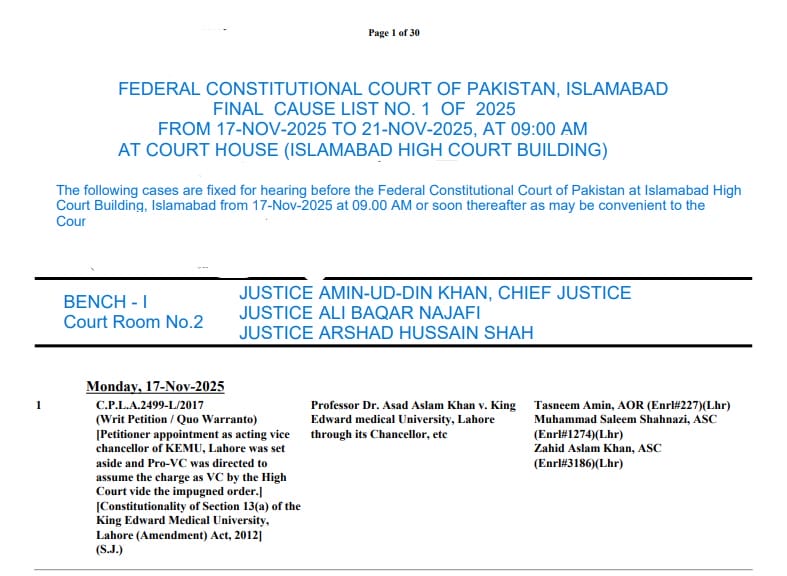
A cause list is a daily or weekly schedule published by higher courts to indicate which cases will be heard, in which courtroom, at what time, and before which bench of judges. In the context of a Federal Constitutional Court, the cause list becomes even more significant because constitutional cases typically involve fundamental rights, division of powers, electoral matters, and questions relating to constitutional interpretation. These cases can shape national governance, correct institutional overreach, and protect citizen liberties.
A cause list generally includes:
Case number and title
Parties involved
Type of constitutional petition or appeal
Assigned bench (single judge, division bench, or full court)
Status of the case (fresh, for hearing, for judgment, etc.)
Advocates or legal representatives
The purpose of publishing the cause list is to ensure transparency, predictability, and access to justice. For lawyers and litigants, it provides essential information for preparation and scheduling. For the public, it reflects how the constitutional court prioritizes matters of national and legal importance.
Functions of a Federal Constitutional Court
Although terminology varies across countries, the functions of a Federal Constitutional Court generally include:
Constitutional Interpretation — determining the meaning and scope of constitutional provisions.
Judicial Review — hearing cases that challenge the constitutionality of laws, executive actions, or institutional decisions.
Protection of Fundamental Rights — deciding claims by citizens alleging violations of constitutional rights.
Federal Dispute Resolution — resolving conflicts between federal and provincial/state governments.
Election and Political Matters — adjudicating disputes related to elections, qualifications of public office holders, or political processes.
In Pakistan, for instance, although there is no formal “Federal Constitutional Court”, the Supreme Court fulfills this mandate. Its cause list includes constitutional petitions under Article 184(3), appeals under Article 185, and suo motu matters—each of which reflects the court’s role as the guardian of the Constitution.
Why the Cause List Matters
The importance of a Federal Constitutional Court Cause List extends beyond mere scheduling:
Ensures Accountability: Publishing the list forces the court to act transparently in selecting and prioritizing cases.
Supports Legal Preparation: Lawyers can prepare arguments and file necessary documents ahead of hearings.
Promotes Public Confidence: Citizens and media can monitor ongoing constitutional issues, fostering trust in judicial processes.
Facilitates Academic Research: Scholars studying constitutional law can observe trends in judicial behavior and docket management.
Moreover, the cause list often signals the urgency or public importance attached to a case. High-impact matters—such as constitutional amendments, elections, or rights-based petitions—are often placed on priority.
Cause Lists in the Pakistani Context
Although Pakistan’s judicial system does not have a court officially named the Federal Constitutional Court, its Supreme Court operates in a functionally similar manner. The Supreme Court Cause List is published regularly on its official website and includes:
This cause list is crucial for understanding how the Court manages sensitive constitutional questions and how its benches are constituted for important legal matters.
Conclusion
A Federal Constitutional Court Cause List—whether belonging to an explicitly named constitutional court or to a supreme court performing constitutional functions—is a central tool for transparency, legal preparedness, and public oversight. In countries like Pakistan, where constitutional litigation shapes national governance, the cause list becomes an important public document that reflects how the judiciary safeguards the Constitution. By examining how these lists are structured and used, one gains deeper insight into judicial independence, constitutional adjudication, and the legal pathways through which citizens seek constitutional justice.